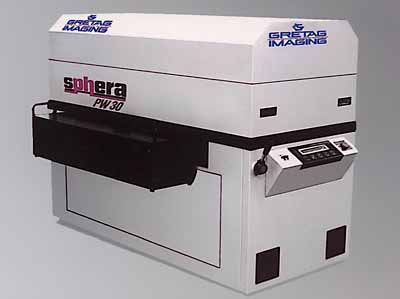
Gretag's Sphera PW30. It takes less than five minutes to expose an image upto 29.5"x50" at 200lpi using this photographic printer.
by John Henshall
There was a time when photographic prints from digital files could be any size and finish you liked - as long as they were up to about A4 paper size and glossy. These were the days when dye sublimation ruled. Only Iris ink jet printers could go significantly larger, to A0, and made a name for themselves as fine art printers in the hands of companies such as Nash Editions of Manhattan Beach, California. But they are not productive enough - each piece of paper must be manually taped to the drum. Apart from these, the best option was to write the file to film, then print by conventional photographic means. But this route could be expensive and the images produced by CRT film writers were fraught with variable quality issues.
Now all that has changed with a choice of direct digital photo writers - some of the biggest SCSI devices to hang on the end of a standard computer workstation. These take the digital files as input and produce exposed photographic print paper as output. Fewer steps between the digital files and finished prints mean faster turnround and potentially lower costs.
Gretag's Sphera PW30. It takes less than five minutes to expose an image upto 29.5"x50" at 200lpi using this photographic printer.
HK Productions Ltd were a London company who introduced the PW30 Digital Photo Writer before being taken over by the Swiss company Gretag AG of Regensdorf in July 1997. Now known by Gretag as the Sphera PW30, this printer takes 30 inch (76.2cm) wide paper in 164 feet (50m) rolls and will print images up to 29.5 inches wide by 40 inches (75 by 101.6cm) at 200lpi/36 bit (res8). Upgrades since the Gretag acquisition of HK include an integrated hardware RIP as standard and a new transport system for the photographic paper. Effects of vibration and temperature on the image are claimed to have been reduced. A maximum size print takes less than five minutes to expose and the printer can be operated in full daylight, thanks to use of cassettes to hold the paper. The PW30 is now shipping, with a UK price of £75,000 (US$125,700) including a Pentium-based workstation to control the printer and control calibration software.
However, the Durst Lambda 130 (first announced at Photokina 1994) can produce prints 50 inches wide and almost any length, using its RGB laser beam to scan the paper as it moves within the printer.
In answer to Durst, Gretag have now announced the Sphera PW52 large format digital photo writer, with an integrated hardware RIP as standard. It, too, takes 50 inch (127cm) wide paper. Shown for the first time at PMA Europe in London in October 1997, the PW52 is expected to ship in February 1998 at a price of £136,000 (US$227,900).
Orthogonal Printing
One of the disadvantages of ultra-wide laser printers is that the laser spot varies from being circular at the center of the print to being increasingly elliptical towards the corners, resulting in distortion and reduced image quality. The PW52 uses a patented system of curving the paper, so that the spot lands orthogonally (at right angles) at every point and avoids this type of distortion. Coupled with the GretagMacbeth Color Management System, extremely accurate colour fidelity is claimed.
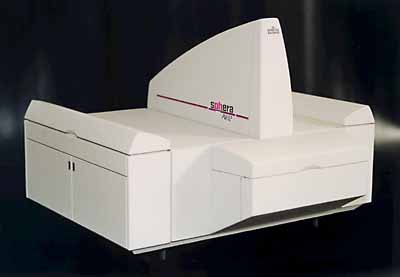
Gretag's new Sphera PW52. Gretag introduced this new photographic printer at the PMA show. It uses three lasers to print up to 50"x60".
The Sphera PW52 uses three lasers: red and green He-Ne of 633 nanometres and 543nm wavelengths respectively, and blue Argon ion at 476nm. Output resolution is 300dpi/36bit (res12) on photographic media. Print size can be 20, 30, 40 or 52 inches wide (depending on cassette loaded) and up to 164 feet (50m) long with continuous feed. Prints wider than 50 inches may be tiled and printed in strips for joining later. Smaller images may be tiled on the media. A 50 x 60 inch print takes only five minutes to write. Like the Sphera PW30, an integrated hardware RIP and controlling workstation are both included.
Banding (scan lines) could be seen on some of the prints on show at PMA Europe, though Gretag's Program Manager Professional Photofinishing, Philippe Flament, stated that these were printed on a prototype printer and that no banding would be visible from production models.
Alongside the PW52's capability to print Color Negative, Reversal, Black-and-White and Display Transparencies, it will also print on Ilfochrome (formerly known as Cibachrome) media. Contrast was always a problem for Ilfochrome when printing direct from transparencies using conventional optical enlargers. Now, contrast can easily be controlled in digital image processing. Ilfochrome's dye stability is a major advantage for archival use. There are other advantages. Kodak have had to design a special RA4 paper for digital printers, to avoid reciprocity failure, but standard Ilfochrome material does not seem to mind the very short exposure times caused by the rapid laser scanning. Another advantage of Ilfochrome is that, before processing, it is black - as opposed to white for other photographic paper - and this greatly reduces scatter of the very bright laser from the surface of the paper. Laser printers such as the PW52 could cause a real revival of interest in Ilfochrome.
The good news for Ilford does not end there. A new alliance gives Ilford worldwide non-exclusive distribution rights to the Gretag Sphera products, confirming a working relationship developed over the past twenty five years.
Real estate requirements become a significant issue for jumbo digital printers. Although the Gretag Sphera PW52 is 84 inches (213 cm) long, by 72 inches (183 cm) wide and 60 inches (152cm) high, this footprint is reasonable for a printer of this size. A very solid floor is needed to avoid laser vibration and to support the weight of 616 pounds (280 Kg).
Digital photo writers make possible conventional 'wet' photographic prints of previously unheard of length. The quality of their prints is already turning heads and will improve even further as competitive products make detailed comparisons easier.
Although the Sphera PW52, Durst Lambda 130 and Cymbolic Sciences Lightjet 5000 photo writers use lasers, the Kodak 'Pegasus' LED Printer 20P uses light emitting diodes. These spin around on a head pivoted at the centre of a drum inside which the RA4 paper is held very accurately in close proximity to the glowing LEDs. Because the LEDs are pivoted at the centre of the drum, they are always at right angles to the paper. The LED head is driven across the width of the paper, scanning it with varying amounts of coloured light to expose the emulsion. This system avoids unevenness of exposure, which has to be compensated for in laser devices. It will only print up to 20 inches wide by 32 inches long, though this is plenty large enough for most applications.
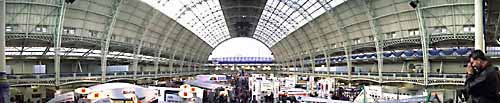
PMA Europe 1997. This panoramic view gives an idea of the size of this London show. Unfortunately, most of the digital cameras and printers on display had already been shown at events in the U.S. or elsewhere.

